Quick answer
Weatherstripping is a targeted option when air moves at the joint between an operable sash and its frame and the window is otherwise in sound condition. Replacement may be worth evaluating when the frame is damaged, the window no longer operates or locks reliably, multiple components are failing, or persistent fog is trapped between insulated-glass panes. A draft alone does not tell you which option is right. Identify the source first, then compare the scope, product, installation details, and warranty in writing.
Why the choice matters
If air seems to come from a bedroom or living-room window, it is tempting to choose the most obvious fix. A roll of weatherstripping appears cheaper than a replacement, while a new window may seem like a permanent answer. But those choices solve different problems. Weatherstripping seals a moving joint. A new window changes the assembly and may address several issues at once, but it can be unnecessary if the actual leak is around the rough opening or elsewhere in the house.
The right comparison starts with the location and condition of the problem. Is the sash loose against its frame? Does the lock pull it evenly closed? Is air coming from the trim-to-wall edge? Is the glass cloudy between panes? Does the window open, close, and stay in place? Those observations help keep a sales conversation focused on the work that is actually needed.
For Van Nuys homeowners, comfort can vary between warm afternoons and cooler evenings, and a room near glass may feel different from an interior room. That local context makes it useful to distinguish a true air leak from cool-glass convection or a heating and cooling issue. It is not a reason by itself to replace a window.
What weatherstripping can and cannot do
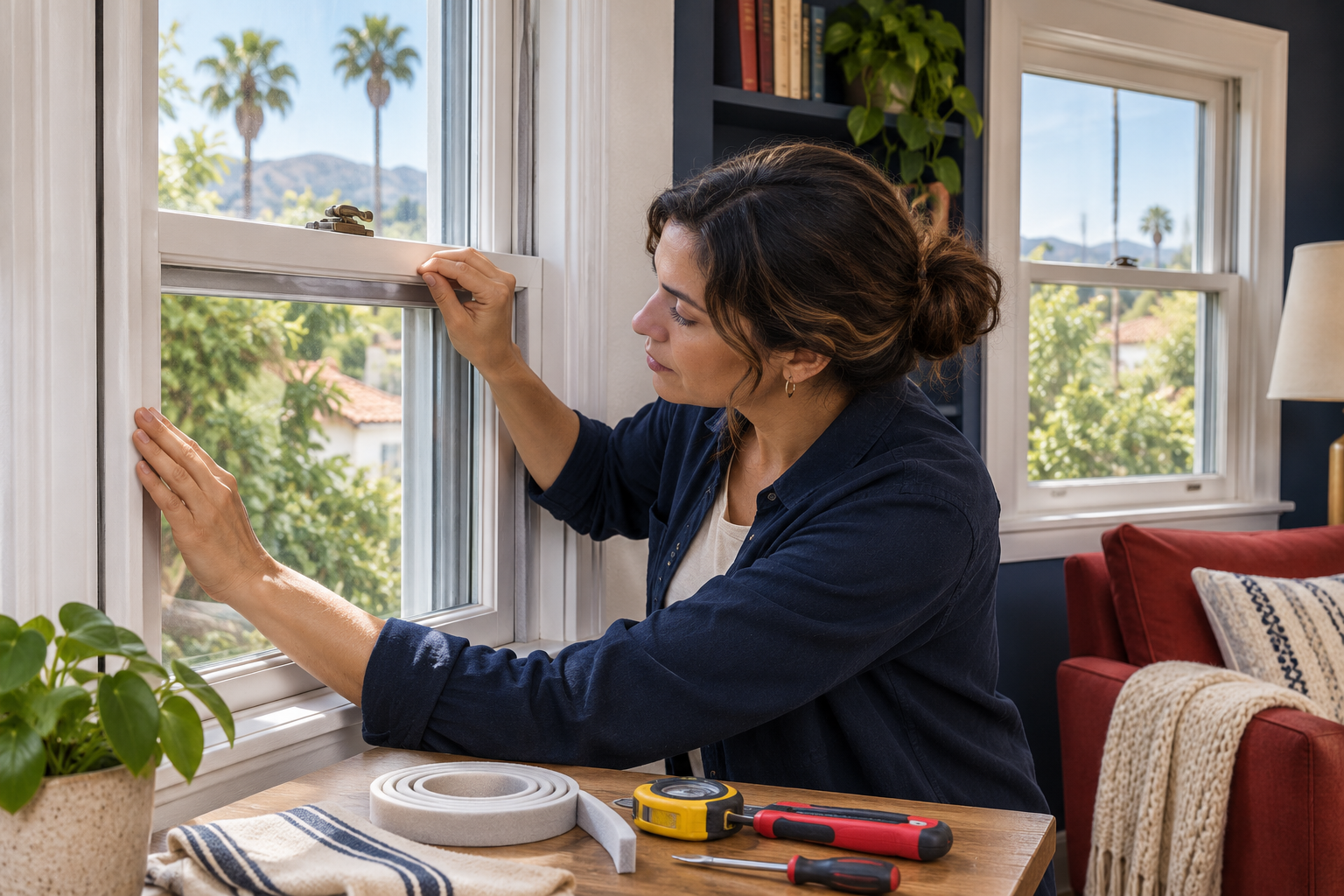
Weatherstripping is a compressible or sliding seal installed where window components move against each other. On an operable window, it can reduce air movement at the sash-to-frame joint when the existing strip is worn, missing, compressed, or poorly fitted. The U.S. Department of Energy describes weatherstripping as a method for moving components such as operable windows, while caulk is generally used for cracks between stationary components.
That distinction is important. Weatherstripping will not repair a cracked or rotted frame, restore a failed insulated-glass seal, realign every damaged sash, or seal a hidden gap around the rough opening. Applying a thicker strip without checking fit may make the sash difficult to close or place extra stress on locks and hardware. A poor fit can also leave uneven pressure: one section may seal while another still leaks.
Before considering replacement, look for basic clues: whether the lock engages; whether the sash sits evenly; whether the weatherstrip is continuous; whether there is visible damage; and whether the paper-strip check feels different at particular points. Do not remove trim or block any drainage openings as a test. If the window is difficult to operate, stop forcing the hardware and note the condition for an assessment.
When replacement deserves a closer look
Replacement is a reasonable topic for an estimate when the window itself has multiple problems or has reached a condition where a targeted repair may not restore safe, reliable operation. Examples include a frame that is visibly deteriorated, a sash that will not stay closed, hardware that cannot secure the unit, recurring water intrusion tied to the assembly, or fog that remains between the panes of an insulated-glass unit.
Replacement can also be considered when several windows have similar defects, when the existing units do not meet a homeowner’s functional needs, or when a renovation already involves work at the openings. These are reasons to compare options, not guarantees that replacement will lower a bill or eliminate every draft. ENERGY STAR advises homeowners to consider the condition of the window, the project scope, and product performance values such as U-factor and solar heat gain coefficient rather than selecting by price or appearance alone.
A new unit cannot correct every source of discomfort. If the air path is in the rough opening and the installation details are not addressed, the symptom can remain after replacement. Likewise, if a room is colder because of duct imbalance, insulation, a large shaded wall, or a cold glass surface, replacing one window may not solve the full comfort issue. Ask the evaluator to explain the diagnosis and installation approach, not simply the product name.
A practical comparison
| Question | Weatherstripping or targeted adjustment | Window replacement |
|---|---|---|
| Best fit | Air at an operable sash joint; frame and glass otherwise appear serviceable | Significant frame, sash, hardware, or glass-unit issues, or broader upgrade intent |
| What it addresses | Contact between moving parts and their frame | The window assembly and the installation work included in the proposal |
| What it may not solve | Rough-opening leaks, cold-glass convection, wall or HVAC issues | Air leakage around the opening if installation details are not addressed; unrelated room comfort issues |
| Information needed | Window type, sash operation, strip condition, lock engagement | Dimensions, frame condition, product options, installation method, finish work, disposal, and permit questions |
| Main comparison point | Is the existing window serviceable and can the source be isolated? | Does the written scope address the actual cause and required opening work? |
The table is a starting point, not a repair prescription. A contractor or window professional should explain whether the symptom comes from the product, the installation perimeter, or another part of the home. If the source is unclear, ask what additional inspection or testing would clarify it.
How to compare the estimate fairly
If you receive replacement estimates, compare like with like. Record the same opening count and approximate sizes, desired window operation, frame and glass options, interior or exterior finish expectations, removal and disposal, and whether permit handling is included or assigned to the homeowner. Ask what installation method is proposed and what conditions could change the scope once the old unit is removed.
For a weatherstrip or adjustment proposal, ask which window and joint will be serviced, what material or part is being used, whether the work preserves normal operation, and what is excluded. If the provider cannot confirm that standalone repair is available, ask before scheduling. American Reliable Windows & Doors currently lists window sales, replacement, and installation; published information does not confirm a separate weatherstripping service.
Do not compare only the total price. A lower bid may omit disposal, finish work, water-management details, or a necessary installation step; a higher price may include options that are not needed. Ask for a written scope that separates product, labor, removals, trim or finish work, permit responsibilities, taxes or fees where applicable, and warranty terms. The California Contractors State License Board recommends comparing written bids that use the same plans, specifications, and scope.
Avoid common mistakes
One mistake is adding adhesive foam or caulk before checking whether the window still opens, locks, and drains correctly. Another is assuming surface condensation proves the glass seal failed. Moisture on the room-facing glass can have different causes from haze trapped between panes. A third mistake is replacing a window because a seat feels cold without checking the frame joint, the glass surface, and airflow in the rest of the room.
Also avoid treating every window in the home as if it has the same condition. A south-facing room, a shaded north-facing room, a room above an unconditioned garage, and a room with a supply register partly blocked by furniture may behave differently. Document which openings show the same symptom and which do not. That makes the estimate discussion more specific and helps avoid expanding the project without evidence.
Do not assume a new window automatically guarantees lower energy use or a specific payback. ENERGY STAR performance depends on product ratings, climate and orientation, installation, and the home’s other air leaks. Ask for actual product performance values and discuss comfort goals separately from energy-cost expectations.
What Van Nuys homeowners can ask during an evaluation
Bring photos, product labels, and notes about when the draft appears. Ask the evaluator to point out the suspected air path and explain whether it is at the sash, frame perimeter, glass unit, or another part of the building. If the answer is replacement, ask why a targeted adjustment or repair is not appropriate for the condition. If the answer is weatherstripping, ask how the window will continue to close, latch, and drain correctly.
The Los Angeles Department of Building and Safety notes that same-size, same-type window and door replacement may qualify for an express permit within the City of Los Angeles, while other scopes may require a different process. A property in Van Nuys should first be checked to see which jurisdiction serves its address; rules can differ across city and county boundaries. Ask who will verify applicable permit requirements and document that responsibility in the estimate.
Questions that make recommendations easier to compare
Ask each provider to identify the component that appears to be failing and explain how that conclusion was reached. A useful answer names the sash, weatherstrip, frame, insulated-glass unit, installation perimeter, or another system instead of relying only on a broad label such as “bad seal.” If the inspection is inconclusive, ask what remains unknown and whether a second type of evaluation is appropriate.
For a repair scope, confirm what the service visit includes and whether parts are available for the window model. For replacement, ask how the old opening will be prepared and sealed, what surfaces will be disturbed, and what is excluded. These questions make it easier to compare recommendations that use different terms. They also help homeowners decide whether to request another opinion before committing to a larger project.
Match the proposed work to the location of the leak
If the symptom appears at the sash joint, ask whether the sash closes squarely, the lock draws it in, and the weatherstrip fits that window model. If air seems to come from the trim-to-wall edge, ask whether the proposal addresses the installed frame perimeter and how the work will preserve water drainage. If you mainly feel a cool downward flow across the glass, a seal replacement may not change that sensation; compare product performance and the room’s airflow before choosing a scope.
For each option, ask the provider to name what will be adjusted or replaced, what surfaces will be disturbed, what finish work is included, and how the window’s operation will be checked afterward. A clear scope makes it easier to compare a targeted repair with a replacement estimate on the same facts.
Frequently asked questions
Is weatherstripping cheaper than replacing a window?
It is often a smaller scope because it addresses a seal at a moving joint, but the actual cost depends on the window type, access, parts, and whether the sash or frame also needs adjustment. Compare a written scope rather than assuming every window can be weatherstripped.
Can I install weatherstripping myself?
Some simple, accessible products are sold for homeowner installation, but the correct type depends on the sash design and clearances. A strip that is too thick can keep a window from closing or locking. Do not cover drainage openings or apply material where it interferes with operation.
Does fog between panes mean I need a whole new window?
Not necessarily. Persistent fog trapped between panes can indicate a failed insulated-glass seal, but the possible replacement scope may be the glass unit, sash, or complete window depending on the product and availability. Identify the product and review warranty terms before deciding.
Will replacement stop drafts in every room?
Not if the cause is elsewhere. A frame-to-wall gap, attic or wall leakage, duct issue, or cool-glass airflow can create discomfort that replacement alone may not correct. Ask the evaluator to identify the air path and explain what the proposal covers.
What should I include in a Van Nuys window estimate request?
Include the number and location of affected windows, what you feel or see, whether each sash latches, photos of visible damage, and any available product label. Ask for the estimate to state product, installation, removal, finish work, permit responsibilities, and warranty terms.
Make the choice after the source is clear
Weatherstripping and replacement solve different conditions. A serviceable sash with a worn seal may call for a targeted approach; a damaged or poorly operating window may justify a replacement estimate. A cold room without moving air calls for a broader comfort check. American Reliable Windows & Doors is based in Van Nuys and lists window sales, replacement, and installation. Review the drafty-window symptoms guide, explore replacement-window options, or request an estimate. Call (818) 787-1101 to confirm whether a specific repair is offered.
Sources
- U.S. Department of Energy: Air-Sealing Essentials
- ENERGY STAR: High Performing Windows and Storm Windows
- California Contractors State License Board: Finding the Right Contractor
- Los Angeles Department of Building and Safety: Contractor Step-by-Step

Elliot Berookhim
With over 15 years of industry experience, Elliot Berookhim specializes in residential window and patio door replacement throughout Los Angeles, California. At American Reliable Windows & Doors, he emphasizes quality materials, trained in-house installers, transparent pricing, and installation practices designed for long-term performance. His firsthand experience helps homeowners avoid common problems such as poor installation, premature window failure, and costly water leaks.