What Happens During a Window Leak Assessment in Pasadena
“Assessment” can mean anything from a replacement estimate to a paid investigation. Confirm the scope, methods, access, written findings, and exclusions before the visit.
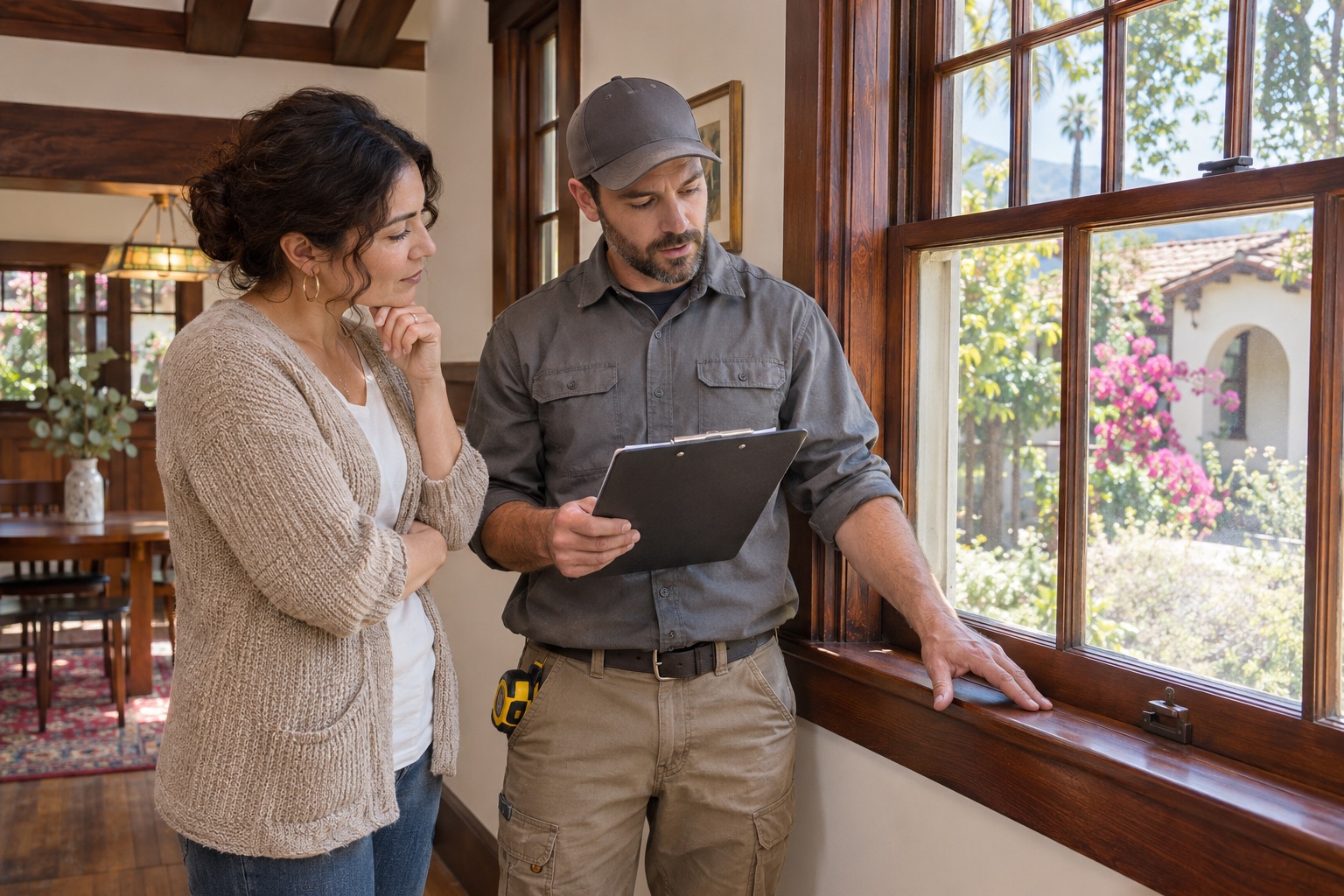
Water around a window can be unsettling, especially after a Pasadena rainstorm when the source is not obvious. Homeowners often want to know whether they need a new window, a repair, or a different trade. The most useful first step is to separate what you observed from what you suspect. A damp sill is a symptom; the path that brought water there still needs to be understood.
First clarify what “assessment” means
A contractor visit may be a sales estimate, a visual condition review, a paid diagnostic inspection, or controlled water testing. Those services are not interchangeable. A replacement estimate may describe a product and installation price without tracing concealed water paths. A diagnostic provider may examine the wall, roof, window, and surrounding construction, but may not offer repairs. Ask which service is being proposed, what it costs, and what information you will receive afterward.
Before scheduling, describe the symptom, when it happens, and what you have already tried. Ask whether the provider evaluates window units, flashing, wall details, roofing, plumbing, or moisture restoration. Ask which parts fall outside its scope and whether it will refer you to another trade if evidence points elsewhere. Clear expectations help avoid the common mismatch where a homeowner expects a forensic diagnosis but receives only an estimate for a replacement window.
For a broader overview, read our Pasadena window leak and moisture guide.
What information to prepare
Create a short timeline of water events: dates, rain or wind conditions, where water first appeared, how much was visible, and whether it returned. Include any recent roof, stucco, painting, plumbing, window, or caulking work. Take a wide photograph and close-ups of the sill, frame corners, wall, and visible exterior. Keep images original with dates when possible. Photos from different weather events can help show whether the pattern is consistent.
Make the area accessible by moving fragile belongings and furniture away from the window. Do not remove trim, cut into drywall, or perform a hose test before the visit. Those steps can alter the evidence or introduce risk. If water is active, protect belongings and dry safely reachable surfaces. If water is near electrical components, do not touch wet equipment. Note any signs of soft wood, peeling paint, odor, or visible growth so the provider knows what has changed.
What a visual review may cover
A scope-appropriate visual review can note window operation, latching, visible frame condition, glazing or joint condition, perimeter sealant, sill slope and drainage features, and signs of staining or deterioration. The professional may also look at the adjacent wall, head flashing, exterior finish, roof edge, gutters, or nearby plumbing based on the reported pattern. The level of access varies. A visual review cannot see inside a concealed wall unless finishes are opened or specialized methods are used.
Ask the evaluator to distinguish observations from conclusions. For example, “paint is peeling at the lower corner” is an observation; “the frame is the leak source” is a conclusion that should be tied to evidence. Ask which alternative sources remain possible and how confident the provider is. The DOE’s Building America Solution Center describes how flashing helps direct water out of a wall opening and warns about blocked weep holes. This is a useful framework for questions, not a substitute for site-specific evaluation.
For moisture-control background, see the EPA’s guide to mold and moisture. Its drying guidance is general and does not replace professional assessment of concealed damage.
Testing, access, and limits
If water testing or moisture measurement is proposed, ask what question the method is meant to answer. Ask where water will be applied, in what sequence, how the area will be monitored, whether the test could increase water entry, and how findings will be documented. A test that sprays a large area at once may show that water entered without identifying the path. More controlled steps can isolate components, but the method should fit the construction and condition.
Some findings require access behind trim or exterior finishes. Ask whether removal is recommended, who will perform it, whether temporary protection and repair of the opened area are included, and what damage could occur. Ask whether the provider will stop if conditions differ from expectations. Measurements and visual clues can help, but they do not always establish the source alone. A credible assessment explains uncertainty and next steps rather than guaranteeing a cause from one quick look.
What a useful written report or estimate includes
For a diagnostic engagement, ask for the reported symptoms, areas inspected, methods used, observations, limitations, likely sources, recommended next steps, and photographs where appropriate. Ask the provider to label items it could not access or verify. For a replacement estimate, ask for the proposed unit, installation details, removal and disposal, opening preparation, flashing or water-management scope, trim and finish work, permits, exclusions, warranty coverage, and how concealed conditions will be handled.
Separate diagnosis from repair pricing when practical. An assessment may not include the cost of opening a wall, repairing wood, painting, or restoring stucco. A replacement quote may omit those scopes too. Ask who is responsible for each piece and whether different trades need to coordinate. Written boundaries make it easier to compare proposals, understand what a price includes, and decide whether another specialist should be involved before approving work.
Questions that help prevent a scope mismatch
Ask: Is this a no-cost estimate or paid diagnosis? What areas will you inspect? Do you perform controlled water testing? Will you inspect the roof or wall assembly? What findings will I receive in writing? Does the proposed work address the source, the window, or only visible trim? What is excluded? What happens if hidden damage appears? Who handles permits and historic review? Ask the provider to answer plainly; the aim is to understand the service before authorizing it.
Also ask whether repair-only work is available and who performs it. Do not assume every window company repairs older wood units, or that every restoration provider replaces modern windows. Verify the contractor’s license status and insurance for the work proposed. Ask for references or examples that match the type of work, while respecting customer privacy. Avoid relying solely on a verbal promise; save the written estimate, report, photos, and any change orders.
See the City of Pasadena historic-preservation information for current project-specific direction.
Pasadena historic-property questions
If a home may be designated or located in a historic district, identify that before authorizing exterior changes. Pasadena lists window replacement among work commonly reviewed for landmark districts. The City says required approval must be obtained before the building permit. Ask staff whether the property is designated and whether the proposed work needs review. Do not assume every Pasadena property has the same restrictions or that interior maintenance triggers the same process.
The City’s historic guidelines favor repairing historic windows when conditions permit and discuss preservation approaches for damaged wood. If original windows matter to the home, request a preservation-focused opinion in addition to a replacement estimate. Ask how replacement would match the original configuration, profile, and appearance if replacement is necessary. Include the time needed for any review in project planning. Always verify current requirements with the City rather than relying on an old checklist or an online summary.
How American Reliable can help—and where to call next
American Reliable Windows & Doors sells and installs replacement windows for homeowners in Los Angeles County. We can discuss the window product and installation scope when replacement may be appropriate. Our published information does not verify standalone leak diagnostics, water testing, caulking, restoration, or repair-only service. Contact us before booking to confirm the kind of visit available. If you need a diagnostic investigation of the full wall or roof, ask a qualified building-envelope contractor, roofer, plumber, or restoration professional as appropriate.
A good next step is to send a short description and the dated photos, then ask whether the request fits the service being offered. If it does, request a written quote that clearly states what is included. If not, getting the right specialist involved first can prevent a new window from being treated as a guaranteed fix for an unrelated source. You can review our Pasadena window installation information or contact us to ask about replacement options.
How to read findings when the source is uncertain
A useful evaluation separates direct observations from working explanations. Observations may include a damp lower corner, a visible gap, soft trim, a blocked drain opening, or a wall stain above the window. A working explanation connects those clues to a likely path. Ask which evidence supports the explanation and what alternate sources remain possible. If the provider could not access the roof, remove trim, or inspect behind the wall, the report should say so. Honest limits are more useful than a confident conclusion that the available inspection did not support.
Ask what level of confidence the evaluator has and what next step would reduce uncertainty. That may mean monitoring a condition during rain, consulting a roofer or plumber, having a building-envelope specialist assess an assembly, or carefully opening a defined area. Each step has a cost, access requirement, and limit. Before authorizing it, ask who performs the work, what will be documented, whether finishes will be restored, and whether the method can worsen water entry.
Assessment notes versus a repair estimate
A report that identifies possible causes is not necessarily a quote to correct them. A replacement estimate may describe a unit and installation price without diagnosing every adjacent wall condition. Ask for a separate cost and scope if both evaluation and repair are offered. For a window replacement proposal, clarify removal, opening preparation, flashing or water-management details, trim, interior finish, disposal, permits, warranty, and what happens if concealed damage appears. For a diagnostic engagement, ask whether the written deliverable includes photographs, methods, findings, limits, and recommendations.
If two providers disagree, compare the methods and access each used rather than simply counting votes. One may have assessed the window operation while another evaluated the roof-to-wall connection. A targeted second opinion from a specialist who covers the disputed component can be more useful than another general estimate. Keep a record of the questions, answers, and documents; it helps the next trade understand what has already been checked.
Questions to ask on the visit day
Before the inspection begins, confirm what areas are included and whether the visit is limited to the room-side window, the exterior frame, or accessible wall and roof details. Ask whether ladders, lifts, or removal of trim are part of the scope. If weather conditions prevent meaningful inspection, ask how the appointment will be handled. If a controlled water test is proposed, confirm the test sequence, how the area will be monitored, and what happens if water begins to enter.
During the review, ask the provider to point out observations and distinguish them from conclusions. Ask whether the moisture pattern is consistent with the proposed source, whether a different trade should be consulted, and what the next step would be if the first theory is not confirmed. If the visit includes measurements, ask which materials were measured and how the readings will be interpreted. Measurements can inform a decision, but they do not necessarily identify where water entered or show every concealed condition.
Before the provider leaves, clarify what you will receive and when: written notes, photographs, a replacement estimate, a diagnostic report, or a referral. Ask whether any work is being recommended immediately and whether you can review the proposal in writing before deciding. Keep the appointment notes with the dated storm photos. A clear record reduces repeated explanations and helps a second provider see what has already been observed.
American Reliable Windows & Doors’ published services are window sales, installation, and replacement. Standalone leak testing, water-intrusion diagnosis, caulking, restoration, and repair-only availability are not confirmed in the public service information. Call to confirm whether the requested work fits our scope.
Frequently asked questions
Is a window leak assessment usually free?
It depends on the provider and purpose. A replacement estimate may be no-cost, while a diagnostic inspection or controlled water test may be paid. Confirm before booking.
Does every assessment include water testing?
No. Ask whether testing is included, what method is used, what areas are covered, and whether findings will be documented in writing.
Can a visual inspection find concealed damage?
A visual review can identify surface clues but may not establish conditions behind finishes. Ask about access limits and whether opening materials is recommended.
What should I bring to the appointment?
A symptom timeline, dated photographs, notes about prior work, and a list of questions about scope, testing, costs, findings, and exclusions.
Does American Reliable provide leak diagnostics?
The company’s public information lists window sales, installation, and replacement. Confirm whether a standalone diagnostic visit is available; do not assume it is included in a replacement estimate.
What if the source is not the window?
Ask the evaluator which trade best fits the evidence. Roofing, plumbing, wall assemblies, and restoration may require different specialists.
Talk through replacement options
If the window itself appears to be part of the problem, share your photos and timeline and ask what a replacement estimate includes. We serve Los Angeles County and can discuss window sales and installation for the scope we confirm.
Request a window estimate · Call (818) 787-1101 · Pasadena service-area information

Elliot Berookhim
Window & Door Installation Specialist
American Reliable Windows & Doors
With over 15 years of industry experience, Elliot Berookhim specializes in residential window and patio door replacement throughout Los Angeles, California. At American Reliable Windows & Doors, he emphasizes quality materials, trained in-house installers, transparent pricing, and installation practices designed for long-term performance. His firsthand experience helps homeowners avoid common problems such as poor installation, premature window failure, and costly water leaks.
✓ CA C-17 License #1025297 ✦ 15+ Years Experience
Published November 17, 2026 · Updated November 17, 2026
